
Google I/O Connect China 2025 Through the Eyes of an AI GDE
What a JAX-on-TPU practitioner took home from Shanghai: Keras 3, modern JAX parallelism, and agents built with ADK

Updated November 2026: I refreshed the code samples so they run on current JAX, Keras, and ADK. Notes about later changes are marked as updates.
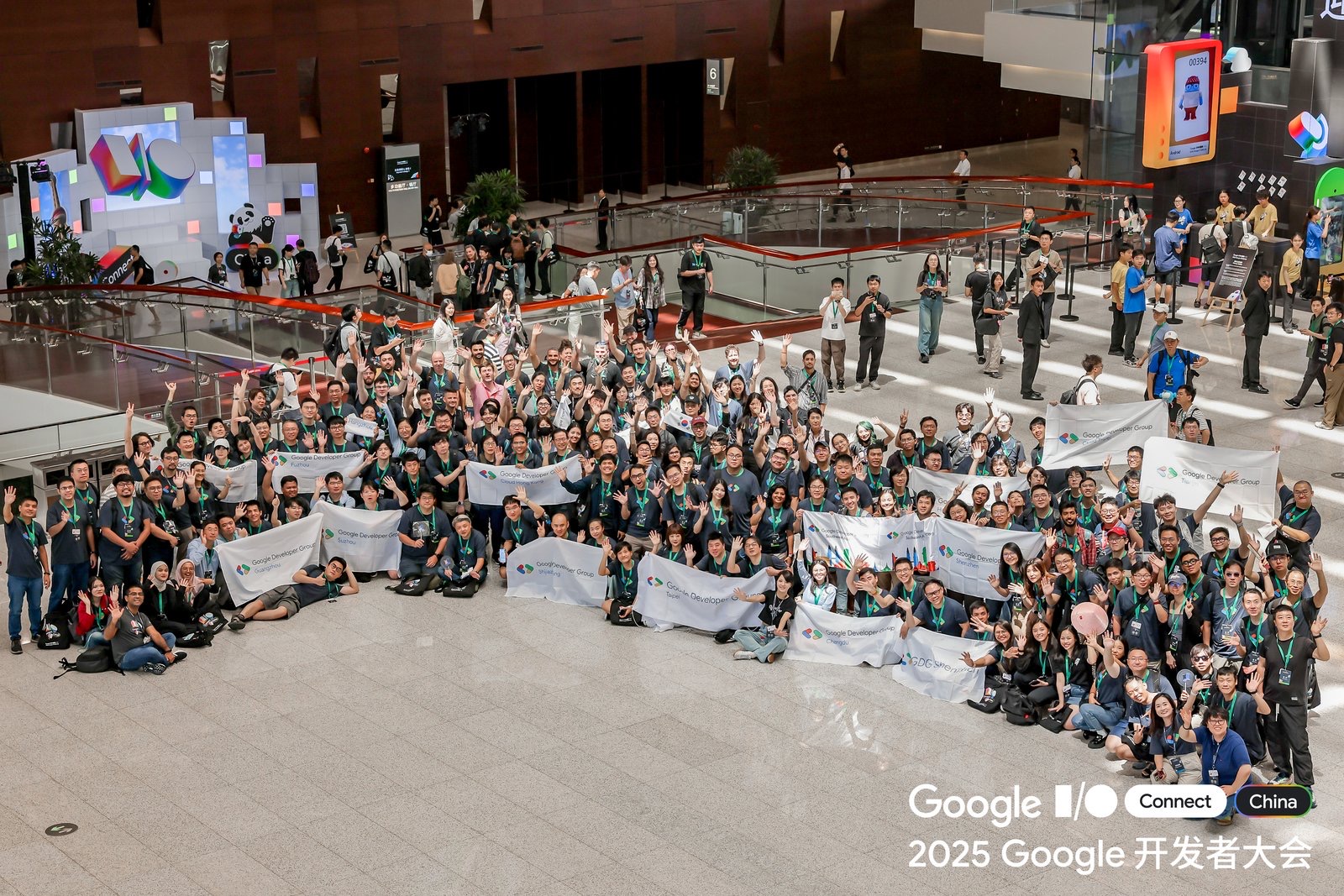
Last week I was in Shanghai for Google I/O Connect China 2025 (August 13–14). It was my first Google event since being selected as an AI GDE (Google Developer Expert) earlier this year, so I went in with high expectations.

If you haven’t been to an I/O Connect before: it isn’t the big product-launch keynote you watch in May. It’s the follow-up, a regional event where Google’s engineers walk developers through how to actually build with what was announced. The Shanghai edition had a clear audience in mind, Chinese developers building products for global markets, and the main stage covered Gemini 2.5, the Gemma open models, and generative media models like Veo 3 and Imagen 4.
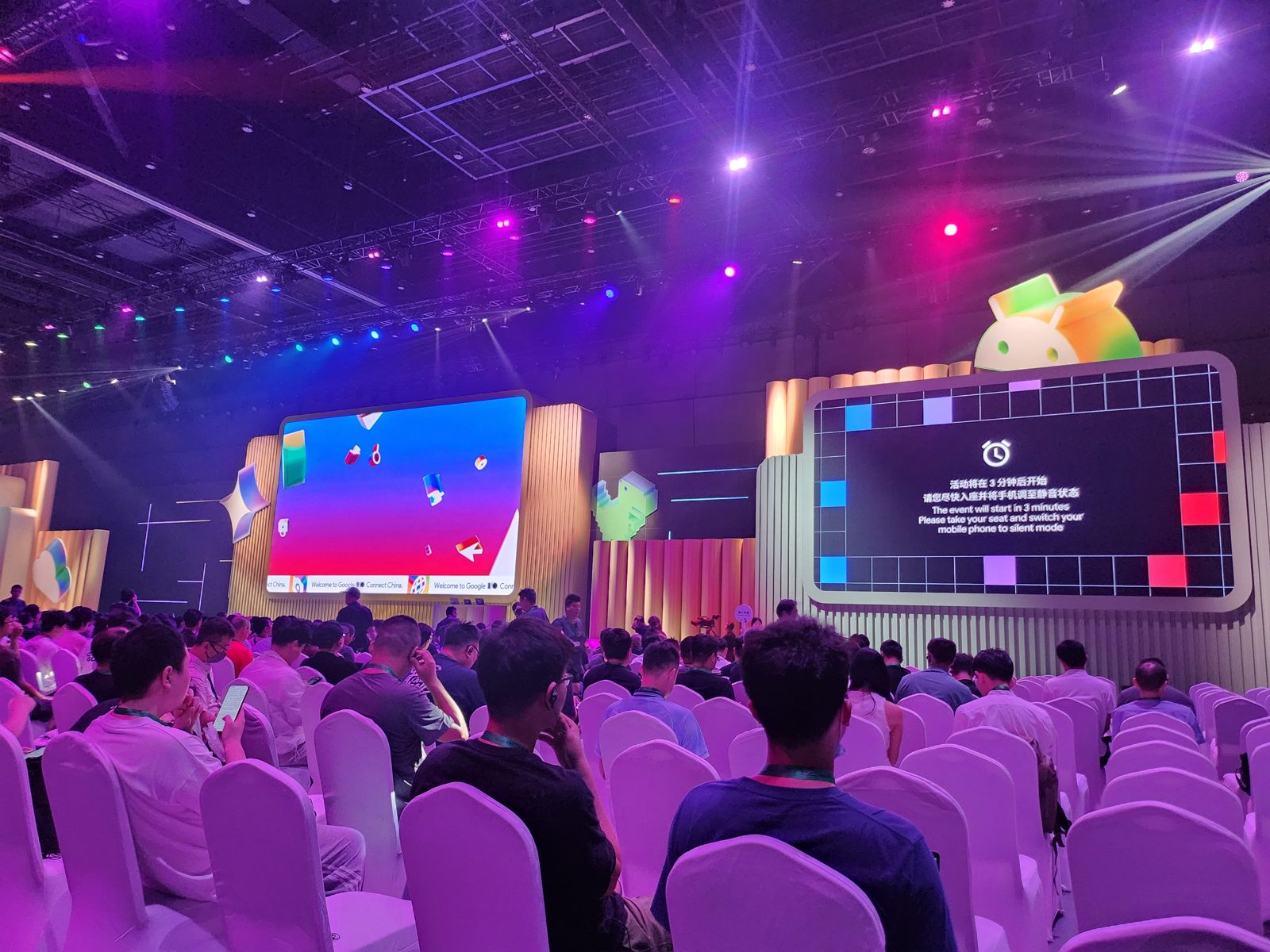
I spent most of my time in the AI and Cloud tracks. This post isn’t a session-by-session transcript. It’s the two ideas I keep coming back to a week later, seen through the lens of my day job: at Kakao, I pre-train large language models with JAX on Cloud TPUs.
TL;DR
- Keras 3 on JAX lets you keep
model.fit()and still drop down to a custom, stateless training step when you need to. The cliff between “easy” and “flexible” is mostly gone.- Parallelism in JAX has moved on from
pmap. The modern way is to describe how your data is sharded and letjitdo the rest.- ADK makes agents feel like ordinary software components: a few agent types you compose into pipelines, instead of one giant prompt.
1. High-performance AI is getting easier to reach
The message from the AI sessions was simple: the stack Google uses to train models like Gemini, JAX on TPUs, is no longer something only a handful of research teams can use comfortably.
Why JAX, in one paragraph
JAX looks like NumPy, but every function you write can be transformed. jit compiles it with XLA, grad differentiates it, and vmap vectorizes it over a batch. You write the math for one example, and JAX handles the rest:
import jax
import jax.numpy as jnp

def loss(w, x, y):                     # math for a single example
    return (x @ w - y) ** 2

batched_loss = jax.vmap(loss, in_axes=(None, 0, 0))   # ...now for a whole batch
grad_fn = jax.jit(jax.grad(lambda w, X, Y: batched_loss(w, X, Y).mean()))

w, X, Y = jnp.zeros(3), jnp.ones((8, 3)), jnp.ones(8)   # toy data: a batch of 8
That composability is the whole point, and it’s why JAX code can stay small even as models get large: you don’t rewrite the model to parallelize it, you change how it’s compiled.
What has changed: you don’t need pmap anymore
If you learned JAX a few years ago, you probably learned pmap for multi-device training. It’s worth knowing that the JAX team now treats pmap as the old way, and the docs recommend migrating. (Update: in later releases, pmap itself was reimplemented on top of jit and shard_map.)
The modern approach is to describe your device layout once, tell JAX how each array is split across it, and let the compiler figure out the communication:
# continues from the snippet above
from jax.sharding import AxisType, NamedSharding, PartitionSpec as P

mesh = jax.make_mesh((jax.device_count(),), ("data",), axis_types=(AxisType.Auto,))
X, Y = jax.device_put((X, Y), NamedSharding(mesh, P("data")))   # split the batch (8 rows) across devices

grads = grad_fn(w, X, Y)   # same jitted function; XLA adds the cross-device reductions
This is the same idea our own training stack was built on. MaxText, Google’s open-source JAX library for LLM training, which we used for pre-training at Kakao and which I contribute to, scales by annotating how arrays are sharded rather than by writing per-device code. When going from a few chips to many is mostly a change to the mesh shape, experimenting gets a lot cheaper. If you do need explicit per-device control, such as custom collectives, shard_map is the tool for that.
Update: on recent JAX releases, make_mesh defaults to explicit sharding, where JAX asks you to spell out how ambiguous results should be sharded. Passing AxisType.Auto, as above, keeps the classic behavior where the compiler decides for you.
Keras 3: no more cliff between easy and flexible
JAX’s functional style is powerful, but it can feel unfamiliar. That’s where the session on training JAX models with model.fit() in Keras 3 came in.
Keras has a design principle called progressive disclosure of complexity: simple things should take one line, and needing something slightly custom shouldn’t force you to throw everything away and write a training loop from scratch.
With the JAX backend, you get there by overriding a single method, train_step. The key difference from other backends is that it’s stateless: it receives the current weights and optimizer state, and returns new ones instead of changing anything in place. Here is the core of it, trimmed down (the official guide has the full version with metrics):
import os
os.environ["KERAS_BACKEND"] = "jax"
import jax
import keras

class CustomModel(keras.Model):
    def train_step(self, state, data):
        trainable, non_trainable, opt_vars, metric_vars = state
        x, y = data

        def loss_fn(trainable):
            y_pred, new_non_trainable = self.stateless_call(
                trainable, non_trainable, x, training=True)
            return self.compute_loss(x=x, y=y, y_pred=y_pred), new_non_trainable

        (loss, non_trainable), grads = jax.value_and_grad(loss_fn, has_aux=True)(trainable)
        trainable, opt_vars = self.optimizer.stateless_apply(opt_vars, grads, trainable)

        # Metric updates omitted for brevity; see the Keras guide.
        return {"loss": loss}, (trainable, non_trainable, opt_vars, metric_vars)

# Everything else stays the same:
# model.compile(optimizer="adam", loss="mse"); model.fit(x, y)
# If you add metrics=[...], update them in train_step too (see the guide).
Why does this matter? Because you can put something unusual, like a GAN or a contrastive objective, inside train_step and still keep everything fit() gives you for free: callbacks, progress bars, checkpointing, distribution. For teams that want JAX’s performance without asking everyone to become a JAX expert first, this is a very practical on-ramp.
2. Agents are becoming software you can compose
The other theme was everywhere: AI agents, meaning systems that don’t just answer a question, but plan, call tools, and keep state across steps. Google’s answer for building them is the Agent Development Kit (ADK).
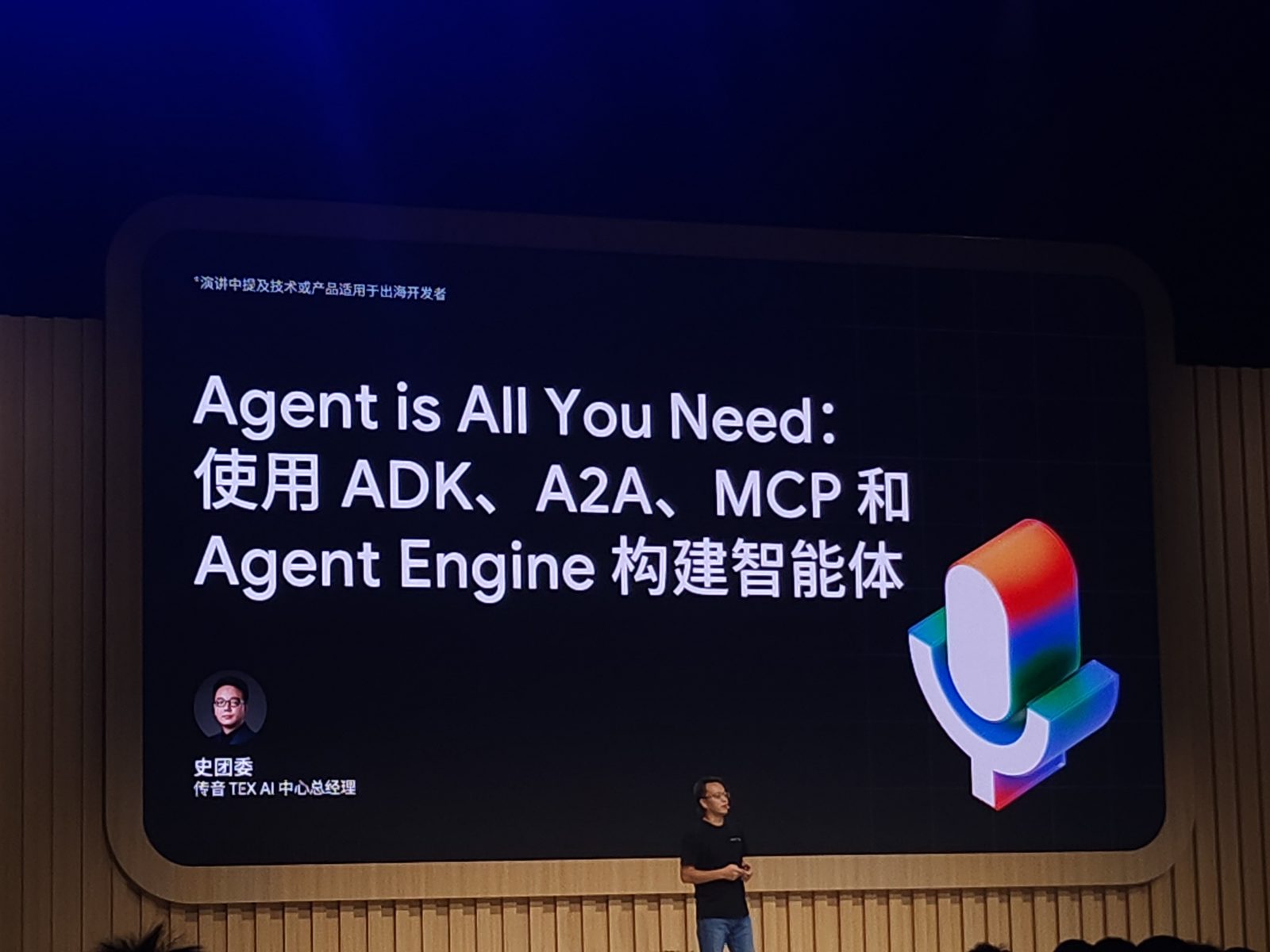
The talk that framed this best for me was “Agent is All You Need: building agents with ADK, A2A, MCP, and Agent Engine”, given by the general manager of the TEX AI center at Transsion, a phone maker that ships to markets around the world. His opening slide described AI as going through three shifts: first, LLMs that can express themselves fluently even in long-tail languages; then models that “think slowly” with chain-of-thought, like Gemini 2.5 Pro; and now agents that can connect and act, linking to outside tools through MCP and to other agents through A2A.
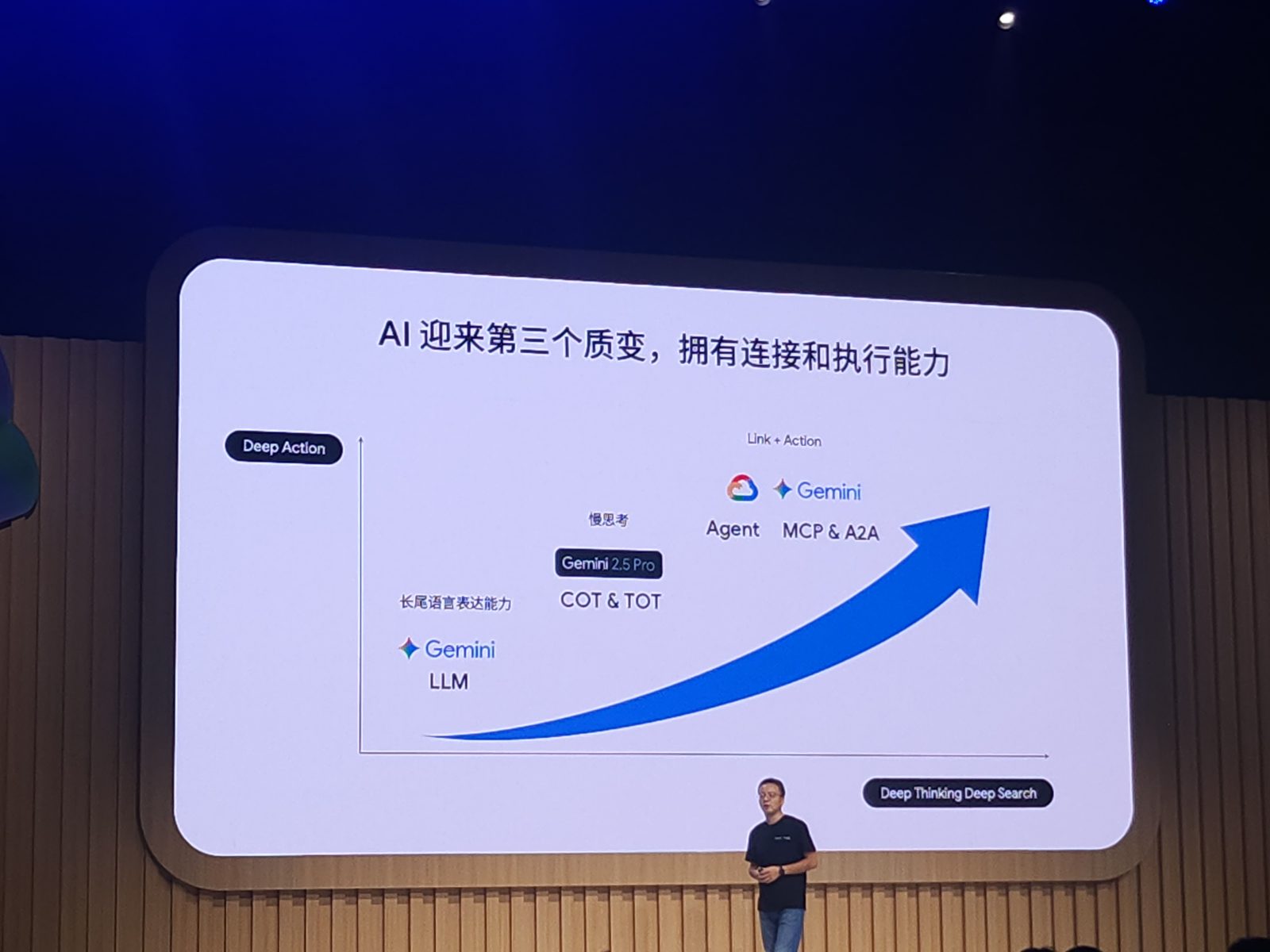
It helps to keep the three pieces apart, because they are easy to mix up:
- MCP (Model Context Protocol) connects an agent to tools and data.
- A2A (Agent2Agent) connects an agent to other agents, even ones built with a different framework.
- ADK is the framework you use to build the agent itself.
What I liked about ADK is that it doesn’t try to be magical. It gives you a small set of agent types and expects you to compose them like regular code.
| Agent type | What it does | Does an LLM decide the flow? |
|---|---|---|
LlmAgent |
Reasons, picks tools, writes answers | Yes |
SequentialAgent, ParallelAgent, LoopAgent |
Runs other agents in order, at the same time, or until a condition is met | No, the flow is fixed |
| Custom agents | Your own Python control flow (branching, retries) | Up to you |
That split is the important design choice. The LLM handles the fuzzy parts, like understanding a request and choosing a tool, while the orchestration stays deterministic and testable.
A small example: an I/O Connect session recommender
Say an attendee asks, “Which sessions should I attend if I care about JAX and agents?” Two agents can search the AI and Cloud tracks in parallel, and a third can merge what they found. The schedule below is mock data, but the structure is real ADK:
from google.adk.agents import LlmAgent, ParallelAgent, SequentialAgent

SCHEDULE = [  # mock data
    {"title": "Training JAX models with model.fit(...) in Keras 3", "track": "AI", "time": "15:20"},
    {"title": "JAX in Practice", "track": "AI", "time": "14:25"},
    {"title": "Agent is All You Need", "track": "Cloud", "time": "10:30"},
]

def list_sessions(track: str) -> list[dict]:
    """Returns every session in the given track ("AI" or "Cloud")."""
    return [s for s in SCHEDULE if s["track"] == track]

ai_search = LlmAgent(
    name="AITrackSearcher", model="gemini-2.5-flash", tools=[list_sessions],
    instruction="Call list_sessions('AI') and keep only sessions about JAX or TPUs.",
    output_key="ai_sessions",            # the answer is saved to shared session state
)
cloud_search = LlmAgent(
    name="CloudTrackSearcher", model="gemini-2.5-flash", tools=[list_sessions],
    instruction="Call list_sessions('Cloud') and keep only sessions about agents or ADK.",
    output_key="cloud_sessions",
)
recommender = LlmAgent(
    name="Recommender", model="gemini-2.5-pro",
    instruction=(
        "Merge these into one short, friendly list with times.\n"
        "AI track: {ai_sessions}\nCloud track: {cloud_sessions}"   # filled in from state
    ),
)

pipeline = SequentialAgent(
    name="SessionRecommender",
    sub_agents=[ParallelAgent(name="Search", sub_agents=[ai_search, cloud_search]), recommender],
)
Three things make this work, and they’re the parts worth remembering:
- Plain Python functions become tools. ADK reads the type hints and the docstring, so
list_sessionsneeds no extra wrapper. output_keysaves each agent’s answer to shared session state, and{ai_sessions}in a later instruction reads it back. That’s how agents hand work to each other.- A fast, cheap model does the searching, and a stronger model does the writing. Choosing a model per step is one of the easiest cost wins in agent systems.
What I’m taking home
A few honest reflections, a week later.
The gap between the “research stack” and everyone’s stack is closing. Not long ago, scaling a JAX model meant learning a fair amount of low-level machinery. Seeing Keras 3 sessions aimed at application developers, built on the same JAX-and-TPU foundation we use for pre-training, felt like a real shift. The tools I use at work are becoming tools I can recommend to anyone.
Agents are turning into an engineering problem, not a prompt problem. The most convincing part of the agent sessions wasn’t any single demo. It was that the hard questions sounded like normal software questions: how components pass state, what can run in parallel, and where you want deterministic control flow. That’s a much healthier place for the field to be.
Being there in person mattered. I could have read about all of this online, but a packed hall of developers building for global markets makes it concrete in a way documentation can’t. As a first-time GDE, it was also a good reminder of what this role is for: helping close the distance between what’s possible and what people actually get to use.

If you want to try any of this yourself, here’s where I’d start:
- Keras 3 + JAX: set
KERAS_BACKEND="jax"on a model you already have, then follow the customtrain_stepguide. - Modern JAX parallelism: read Distributed arrays and automatic parallelization, and the
pmapmigration guide if you have older code. - ADK: build one
LlmAgentwith a single tool, then wrap two of them in aParallelAgent.
Thanks to the Google for Developers team and everyone I met in Shanghai. See you at the next one.